
The Great Indian Reset: Deconstructing Sensex’s 13.22% Slump Against Regional Giants
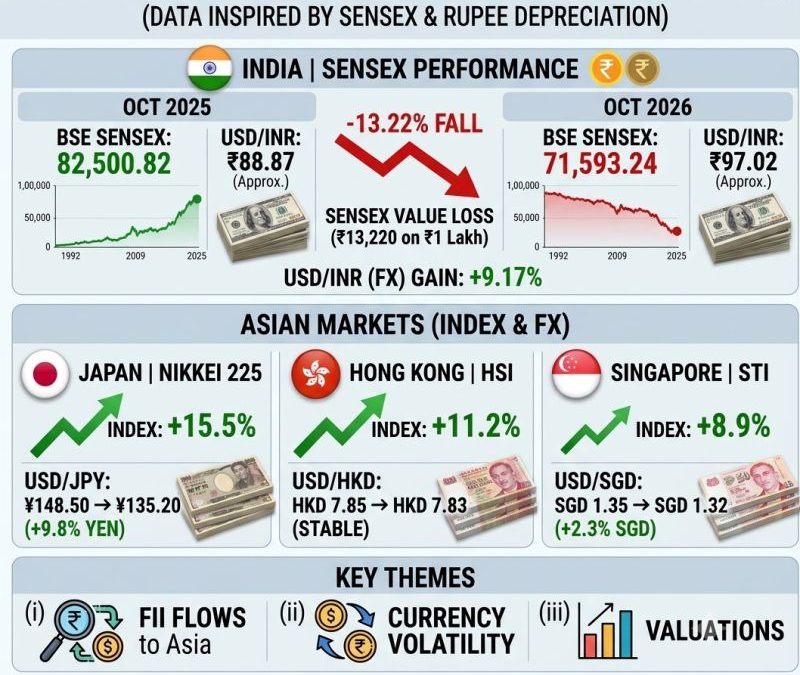
Between October 10, 2025, and October 8, 2026, the BSE Sensex recorded an annual contraction, dropping from 82,500.82 to 71,593.24 points , a nominal loss of 13.22%.
While major East Asian equity benchmarks like Japan’s Nikkei 225, Taiwan’s TAIEX, and South Korea’s KOSPI benefited from a global semiconductor surge and corporate governance reforms, India’s domestic equities faced sustained selling pressure.
For localized retail investors, this drawdown translated into direct financial value erosion, reducing a ₹1,00,000 portfolio to ₹86,780 (a ₹13,220 loss) and cutting a ₹1,00,00,000 allocation down to ₹86,780,000 (a ₹13,22,000 loss).
This underperformance highlights a stark divergence between India’s broader domestic market dynamics and the technology-driven rallies seen across key Asian indices.
The Dual Squeeze: Rupee Depreciation Amplifies FII Capital Outflows
A significant driver of the Sensex’s annual drop lies in the macroeconomic dynamics of FX depreciation and foreign capital rebalancing.
Over the same 12-month period, the Indian Rupee depreciated significantly against the US Dollar, moving from ₹88.87/USD to ₹97.02/USD—a 9.17% currency decline.
When calculated in US Dollar terms for global institutional allocations, the effective return on the BSE Sensex experienced a cumulative drag of approximately 21.2%, compounding the equity market index drop with foreign exchange loss. High valuation multiples in India relative to regional peers prompted Foreign Institutional Investors (FIIs) to reallocate capital toward cheaper Asian markets, accelerating a sell-off that amplified pressure across domestic large-cap equities.
Valuation Correction vs. Regional Tech Tailwinds: Quantifying the Shift Quantitatively, the underperformance of the BSE Sensex relative to broader Asian indices reflects both elevated local valuations and sector specific global tailwinds favoring regional peers.
Entering late 2025, the Sensex traded at a steep premium compared to historical averages and neighboring emerging markets. As corporate earnings growth slowed relative to those rich market multiples, a valuation contraction ensued.
Concurrently, Asian benchmarks with heavy weightings in hardware technology and artificial intelligence supply chains captured significant foreign capital flows, while India’s index composition skewed heavily toward financial services, oil & gas, and traditional consumer sectors remained vulnerable to elevated inflation, high borrowing costs, and foreign portfolio reallocation.

Author Sa. Venkat Ramanujan is a Certified Environment Social Framework Specialist of Word Bank Group and also Certified Independent Director of IICA, Ministry of Corporate affairs , Govt of India .,
He is Member of Institute of Directors & All India Management Academy ( AIMA ) .,
He is Founder & CEO of Trust Infosys Incorporation – Govt. of India accredited startup venture ., A distinction holder in his Post graduate MBA studies and a sustained learner for three decades in the domains of engineering & infrastructure projects , international trade & contracts , data & cloud management , environmental, social & corporate governance.,
Environmentalist ., Voracious reader., interested in cats and dogs ., love Gardening ., reuse & recycler of natural resources .,
for more details check in >> venkatramanujam.in