
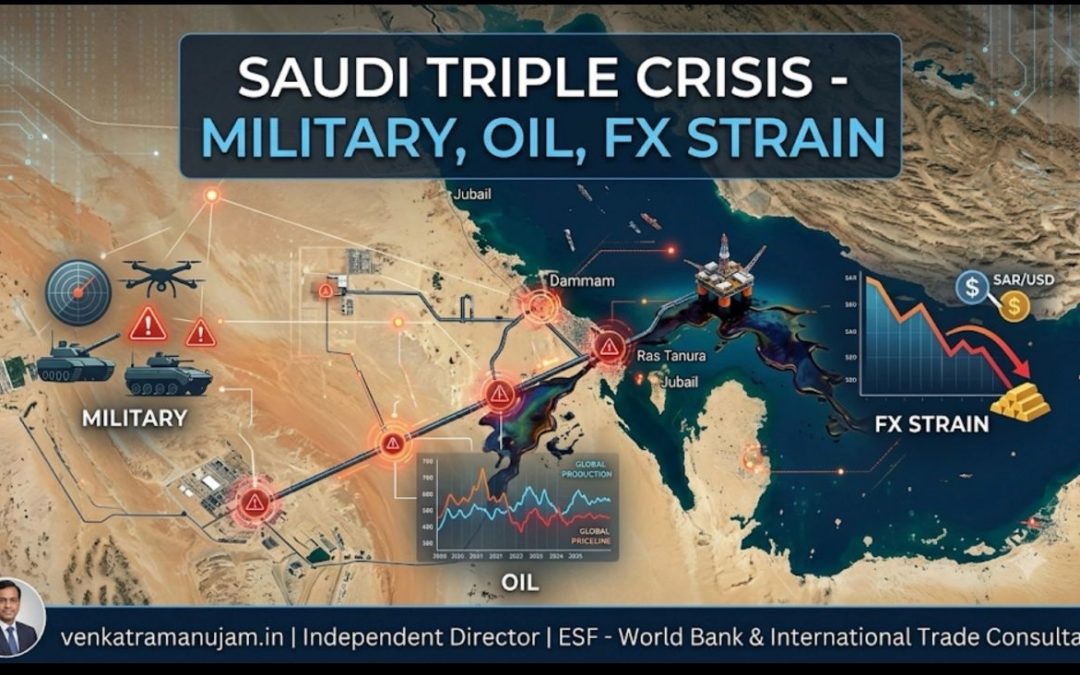
The 2026 US-Iran conflict has turned the Strait of Hormuz into a flashpoint that is hitting Saudi Arabia hard than any other Gulf regions
Iranian missile and drone strikes, Houthi attacks from Yemen, and disruptions to key export routes have created overlapping military, energy, and financial pressures on the Kingdom.
Military Toll :
Since the war began in late February 2026., facilities in the Eastern Province, Aramco sites, and even US assets at bases such as Prince Sultan Air Base have been targeted. The net effect is stretched defenses, damaged energy and military infrastructure, and a reminder that Gulf security cannot be fully outsourced.
Crude Oil Disruptions: From Hormuz Closure to Pipeline Shutdown
Around 10–11 September 2026, drones launched from Iraqi territory struck pumping stations and related infrastructure along Saudi Arabia’s East-West Crude Oil Pipeline (also known as Petroline).
The ~1,200 km line runs from the eastern oil fields (near Abqaiq) to the Red Sea port of Yanbu. At ~4 million bpd and oil prices in the $100–110 range (Brent briefly exceeded $105–110 after the news), the gross value of the disrupted volume is on the order of $400–440 million per day.
Foreign Exchange & Question of External Financing:
Early in the conflict, Saudi Arabia recorded a sizable first-quarter budget deficit. Foreign exchange reserves have fluctuated; official data showed levels around $460–490 billion range in recent months (with some monthly declines noted), still substantial but under pressure from the prolonged disruption.
Current Debt Profile (as of mid-2026)
• Stock: Approximately SAR 1.68–1.69 trillion by Q2 2026 (around $450 billion), up from ~SAR 1.52 trillion at end-2025.
• Debt-to-GDP: Roughly 33–34% (projections for full-year 2026 around 33–35%, depending on GDP outcomes). This is still low internationally and leaves substantial room.
• Government deposits at SAMA and foreign reserves provide additional liquidity buffers (deposits often cited around 8% of GDP), so the Kingdom prefers borrowing over heavy reserve drawdowns.
The Kingdom retains significant fiscal buffers, sovereign wealth resources, and market access. It is not currently in a position that requires an IMF program.
However, if the Hormuz and Red Sea constraints persist and oil export revenues stay depressed for an extended period, further drawdowns on reserves or increased borrowing (domestic or international) become more likely.
Officials have emphasized resilience, but the trajectory depends heavily on how quickly shipping corridors stabilize. The coming weeks of pipeline repairs, Houthi activity, and any progress on Hormuz arrangements will be decisive.

Author Sa. Venkat Ramanujan is a Certified Environment Social Framework Specialist of Word Bank Group and also Certified Independent Director of IICA, Ministry of Corporate affairs , Govt of India.
He is Member of Institute of Directors & All India Management Academy ( AIMA ),
He is Founder & CEO of Trust Infosys Incorporation – Govt. of India accredited startup venture, A distinction holder in his Post graduate MBA studies and a sustained learner for three decades in the domains of engineering & infrastructure projects , international trade & contracts , data & cloud management , environmental, social & corporate governance.,
Environmentalist, Voracious Reader, Interested in Cats and Dogs, Love Gardening, Reuse & Recycler of Natural Resources,
for more details check in >> venkatramanujam.in