
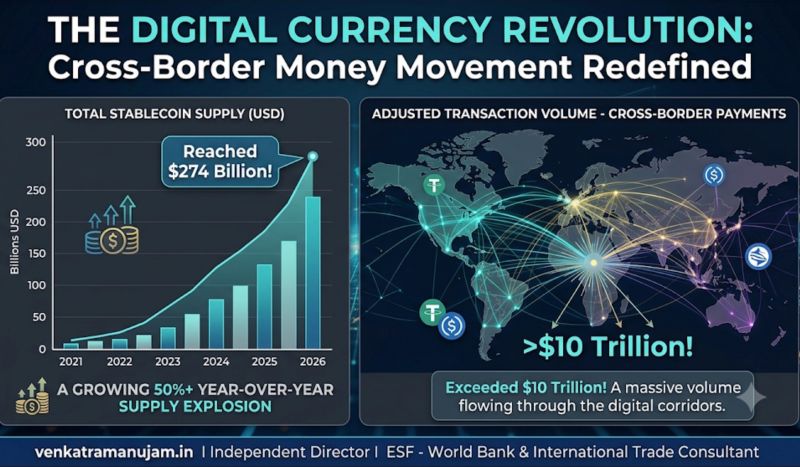
Stablecoins have become a settlement layer :
The role of Stablecoin can no longer be ignored in cross-border money movement. In 2025, stablecoin supply grew by over 50%, reaching $274 billion, with adjusted transaction volume exceeding $10 trillion.
Stripe’s data shows that businesses with over $1 million in monthly cross-border volume are 92% more likely to use stablecoins than others, and in Sub-Saharan Africa, stablecoins already account for 43% of transaction volume. Visa has over 130 card programs underpinned by stablecoin wallets, meaning stablecoins are transitioning from a “crypto-native tool” to a base liquidity layer for payment networks.
Tokenised central bank money:
Tokenization solves a different layer of the problem giving traditional bank liabilities and financial assets programmability and real-time settlement capability. The BIS’s Project Rialto demonstrated that retail cross-border payments can achieve synchronized delivery-versus-payment through interconnected instant payment systems and tokenized central bank money, thereby eliminating principal risk in foreign exchange settlement.
Work by ISDA and Ant International under Project Guardian further shows that tokenized bank liabilities combined with shared ledgers can compress cross-border settlement times to minutes or even seconds, and could reduce cross-border transaction costs by 12.5% by 2030, saving businesses over $50 billion.
AI agents are the third thread, and the most radical:
Mastercard has completed real-time end-to-end AI agent payment transactions in Latin America and the Caribbean, where AI agents autonomously complete the entire search, recommendation, and payment process under explicit cardholder authorization.
Santander and Mastercard completed Europe’s first AI agent payment protected by a regulatory framework, signaling that this model has entered the core business vision of mainstream banks. As these three threads converge, the shape of cross-border payments is shifting from “human-driven pipes” to “agent-driven liquidity orchestration.”
To summarise ., Stablecoins provide liquidity, tokenization provides programmability, and AI agents provide efficiency but the risk surface created by the three combined is far greater than the sum of their individual risks.
True security strengthening is not about reinforcing any single technological rail, but about building a cross-layer trust architecture that can verify “who authorized what” at runtime.
Without that architecture, the efficiency gains of agentified payments will rest on an unauditable authorization chain and that would be a costly gamble.
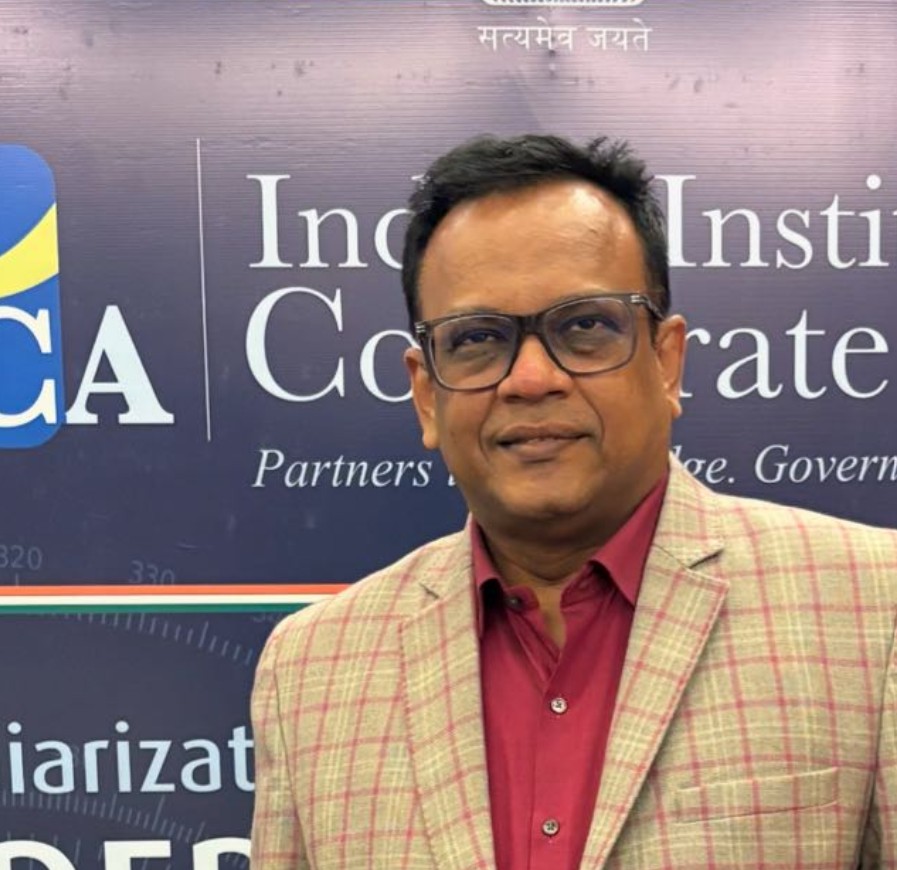
Author Sa. Venkat Ramanujan is a Certified Environment Social Framework Specialist of Word Bank Group and also Certified Independent Director of IICA, Ministry of Corporate affairs , Govt of India .,
He is Member of Institute of Directors & All India Management Academy ( AIMA ) .,
He is Founder & CEO of Trust Infosys Incorporation – Govt. of India accredited startup venture ., A distinction holder in his Post graduate MBA studies and a sustained learner for three decades in the domains of engineering & infrastructure projects , international trade & contracts , data & cloud management , environmental, social & corporate governance.,
Environmentalist ., Voracious reader., interested in cats and dogs ., love Gardening ., reuse & recycler of natural resources .,
for more details check in >> venkatramanujam.in